
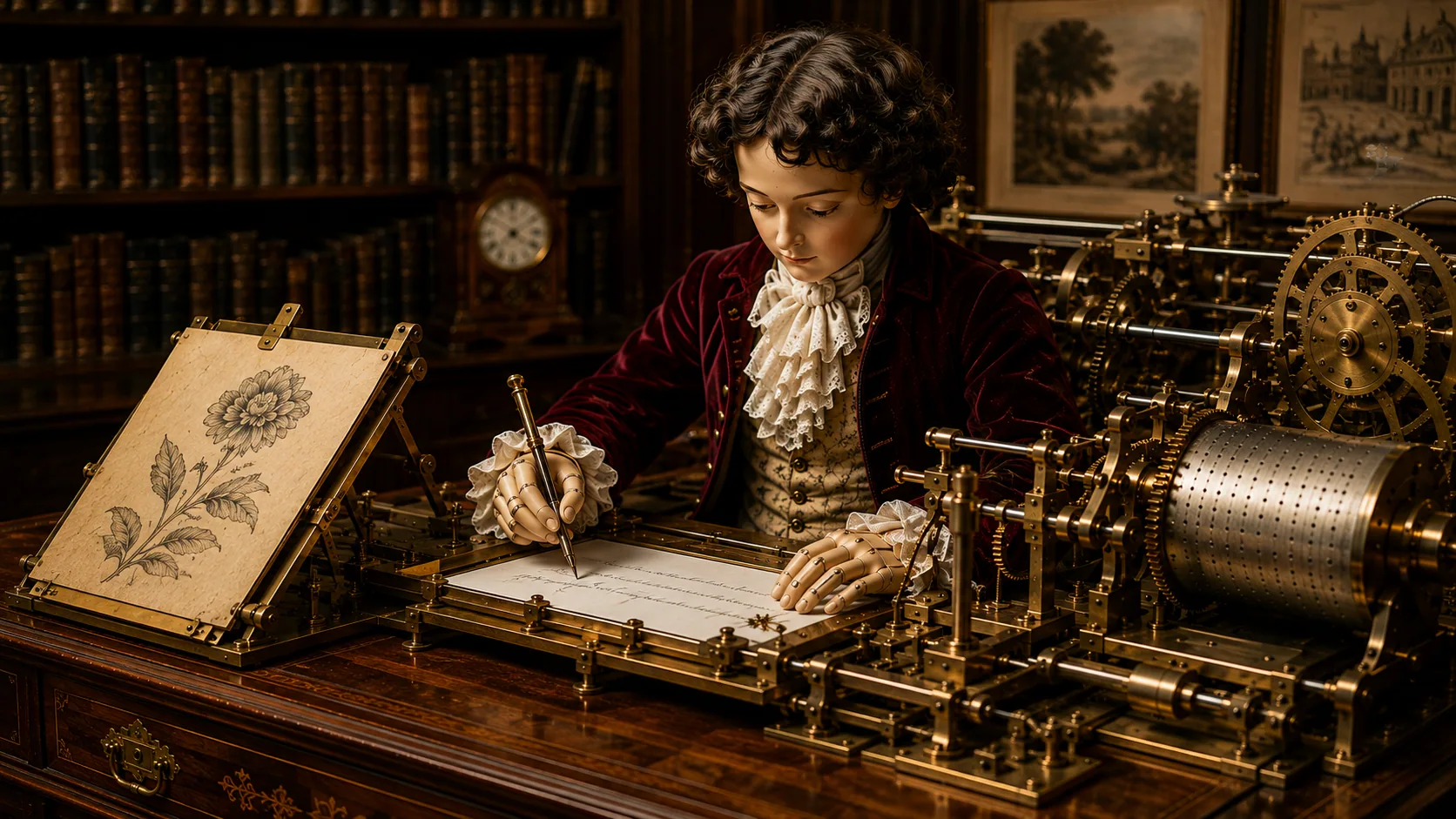
There is something wonderfully strange about a machine that can tell you who made it. Not through an engraved maker's plate hidden beneath a panel, nor through a name stamped onto one of its gears, but by picking up a pen and writing the answer itself. That is essentially what happened when a badly damaged mechanical automaton arrived at The Franklin Institute in Philadelphia in 1928.
The machine had survived more than a century, a fire, years of neglect and the loss of much of its history. Nobody at the museum initially knew exactly what it was. The answer was still inside it. Stored in brass.
A machine arrives with no name
In November 1928, a truck arrived at The Franklin Institute carrying the pieces of a complex but badly damaged brass machine. It had been donated by the estate of John Penn Brock, a wealthy Philadelphian. The Brock family understood that the machine had been damaged in a fire and believed it had been made by Johann Maelzel, the nineteenth-century showman and mechanician associated with a number of famous mechanical exhibitions. Beyond that, its history was uncertain.
The machine did not arrive as the elegant museum exhibit we might imagine today. It was effectively a mechanical puzzle: an intricate collection of gears, cams, rods and linkages that had not operated properly for years. A mechanic at the Institute began working on it. Eventually, the mechanism moved again.
The figure lowered its head. It positioned its writing instrument. And it began to draw.
What emerged was not a crude collection of mechanical lines. The machine could produce elaborate drawings and carefully formed writing. More remarkably, it wasn't limited to a single performance. Hidden inside the mechanism were the instructions for four drawings and three poems — two poems in French and one in English.
For a machine believed to have been constructed around 1800, that represented an extraordinary amount of stored behaviour. And then the automaton revealed something else.
The machine signs its own name
As the restored machine worked through its repertoire, it eventually produced its final poem. Around its border appeared an inscription:
“Ecrit par L'Automate de Maillardet.”
Written by the Automaton of Maillardet. The Franklin Institute describes this as the first important clue to the machine's true identity. The mechanism had effectively preserved the name of its creator for more than a century.
Its mechanical memory had outlasted the human memory of what the machine actually was. The name pointed researchers towards Henri Maillardet, a Swiss mechanician who worked in London producing clocks and other sophisticated mechanisms. Maillardet had also spent time working in the workshops of Pierre Jaquet-Droz, one of the great names in eighteenth-century automata.
The Franklin Institute believes Maillardet constructed the machine around 1800. Today it is generally known as Maillardet's Automaton, or the Draughtsman-Writer. But its ability to identify itself is only part of what makes it interesting.
The more fascinating question is how a machine built two centuries ago could remember enough information to reproduce drawings and poetry.
Seven performances stored in brass
There is no electronic memory inside Maillardet's machine. No processor. No magnetic storage. No software. Instead, its information is physically embodied in the mechanism. The key components are large cams — shaped brass elements whose contours encode movement.
As the clockwork mechanism turns them, steel followers trace their changing surfaces. Those movements are passed through a complex system of rods and levers until they reach the automaton's writing hand. The mechanism controls movement in three directions:
- side to side;
- forwards and backwards;
- up and down.
Together those movements allow the hand to travel across the paper, lift when necessary and return to the surface at another position. The result is remarkably similar to the problem faced by a modern plotting machine or robotic arm. The mechanism needs to determine where the tool should be, how it should move and when it should make contact with the working surface.
Maillardet solved that problem entirely mechanically. The shapes of the cams contain the information required to recreate the performance. Change the stored mechanical pattern and you change what the machine does.
Mechanical memory
The word memory deserves a little care here. Maillardet's Automaton does not remember in the human sense. It does not recall previous experiences, learn new drawings or decide what it wants to write next. Its behaviour is predetermined.
But there is still information stored inside the machine. The Franklin Institute describes the automaton as having the largest memory of any machine of its type, capable of producing four drawings and three poems. Maillardet achieved this partly by making an important architectural decision.
Rather than trying to fit the entire mechanism inside the body of the figure, much of the machinery was placed inside the large chest forming the machine's base. That provided considerably more room for the cams and mechanisms required to store its repertoire. The result is a fascinating example of a problem that software engineers still recognise:
storage capacity affects what a system is capable of doing. The technology is radically different. The principle is surprisingly familiar.
Is a brass cam a program?
Calling Maillardet's Automaton a computer would stretch the meaning of the word too far. Calling it artificial intelligence would be worse. The machine doesn't reason. It doesn't learn. It doesn't understand the poems it writes or the pictures it draws.
But there is a useful comparison with programming. A program is, at its simplest, a representation of instructions that a machine can execute. In a modern computer those instructions might ultimately be represented as binary values stored electronically.
In Maillardet's machine, behaviour is encoded in physical geometry. The contours of a cam determine the movements that follow. The mechanism reads those contours mechanically and converts them into action.
That doesn't make the cam software. But it does make it an intriguing ancestor of an idea that sits at the heart of modern computing: separate the description of a behaviour from the machinery that performs it.
The same underlying mechanism can produce different outputs because different patterns of movement have been encoded into it. The machine is not improvising. It is executing.
From Automaton to Autonomous
This is where an eighteenth-century mechanical curiosity starts to feel surprisingly relevant to modern technology. The words automaton and autonomous sound similar, but they describe very different ambitions. An automaton follows behaviour that has been designed into it.
A modern autonomous system is expected to do something more. It may sense its environment. It may choose between actions.
It may respond differently when circumstances change. Increasingly, software agents can select tools, gather information, plan intermediate steps and alter their behaviour according to the results they receive. The distance between Maillardet's cams and a modern AI agent is enormous.
Yet both begin with a question that engineers have been asking for centuries: How do we put behaviour into a machine? For Maillardet, the answer involved brass, steel, springs, cams and extraordinarily precise craftsmanship.
For today's developers, the answer might involve code, data, APIs, models and instructions written in natural language. The materials have changed. The ambition has grown.
But the desire to make machines perform increasingly sophisticated behaviour is much older than computing.
The illusion of intelligence
Automata were designed partly to amaze. Their appeal wasn't simply that gears turned successfully. Audiences could already see mechanical devices doing useful work. What fascinated people was the appearance of life.
A figure writing a poem creates a very different emotional response from watching the gears inside a clock. We instinctively pay attention to behaviour that looks purposeful. That remains true today.
Modern AI systems can produce an even stronger effect because they generate language, images and actions that appear responsive rather than completely predetermined. It is tempting to move immediately from sophisticated behaviour to assumptions about intelligence. Maillardet's machine provides a useful reminder to be cautious.
Its handwriting can look purposeful. Its drawings can look deliberate. It can even appear to sign its own name.
Yet every movement ultimately comes from information carefully encoded into its mechanism by human ingenuity. Understanding the mechanism doesn't make the performance less impressive. If anything, it makes it more so.
A machine built to perform
Maillardet did not create his automaton simply to sit quietly in a workshop. According to research documented by The Franklin Institute, the machine was exhibited around England and appears to have travelled through continental Europe, possibly reaching as far as St Petersburg. After 1833, its history becomes much less certain.
There has been speculation about whether P. T. Barnum may have played some part in bringing it to the United States, but the Institute treats this part of the story as conjecture rather than established fact. Somewhere along the way the automaton was badly damaged by fire. Eventually it passed into the possession of the Brock family.
And in 1928 it arrived, in pieces, at The Franklin Institute. The machine had travelled for more than a century while much of the story surrounding it disappeared. But the information encoded into its mechanism remained.
The machine that remembered
There is a pleasing symmetry to Maillardet's story. A human built a machine capable of storing a series of performances. The machine passed through generations of human owners.
Its history became confused. Its creator was forgotten. Then, more than a century later, the mechanism was repaired and allowed to execute its instructions again.
It drew its pictures. It wrote its poems. And buried inside one of those performances was the information needed to reconnect the machine with the person who had built it.
The automaton didn't know Henri Maillardet. It didn't remember him. But Maillardet had encoded enough information into brass for his machine to carry his name into the future.
For Cog & Code, that is what makes this more than a beautiful mechanical curiosity. It sits on a long line connecting mechanical invention with modern intelligent software. Not because Maillardet built artificial intelligence two hundred years ago. He didn't. But because he was wrestling with a problem we are still exploring today: How can an idea become a set of instructions, and how can a machine turn those instructions into action?
Maillardet answered with cams, gears and levers. Today we answer with code. What comes next may look different again.