
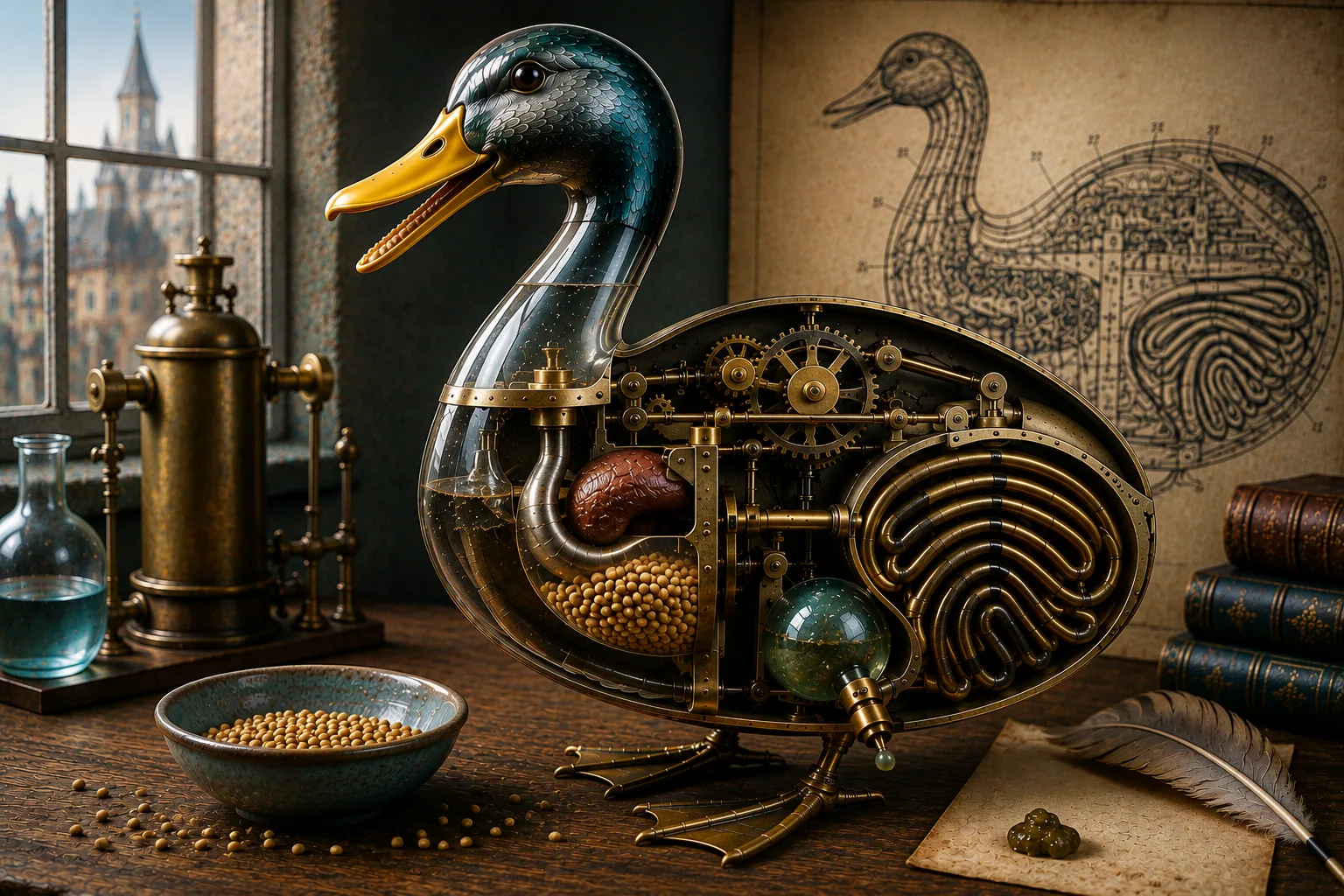
In Paris in 1738, audiences were invited to witness something extraordinary. Before them stood a mechanical duck.
It was not simply a carved bird attached to a clockwork mechanism. It moved. It stretched and turned its neck, opened its beak and moved its wings. When offered grain, it appeared to eat. When given water, it drank.
Then, after a suitable interval, the duck did something considerably more memorable.
It defecated.
To an eighteenth-century audience, this was more than an amusing mechanical trick. The machine appeared to have taken food into its body, processed it and expelled the waste. Somewhere inside that intricate construction of metal, tubes and mechanisms, digestion seemed to have taken place.
It hadn't.
But to understand why people believed that it had, we first need to understand the man who built it — and the remarkable machine surrounding the trick.
Jacques de Vaucanson
Jacques de Vaucanson was born in Grenoble in 1709, into a Europe increasingly fascinated by the idea that nature itself might be understood through mechanism. Clockmakers were constructing ever more elaborate machines. Anatomists were revealing the structures hidden inside human and animal bodies. Philosophers and scientists were asking whether processes that had once seemed mysterious might instead be explained through physical laws.
The idea that an animal could, at least in some respects, be understood as a machine was not new. René Descartes had argued in the previous century for a mechanical understanding of animal bodies. Muscles, joints, circulation and movement could increasingly be considered not merely as mysteries of life, but as systems.
Vaucanson took that idea somewhere unusual.
He built the systems.
His fascination with mechanical devices led him to construct automata capable of reproducing surprisingly complex human and animal behaviour. These were more than decorative figures which happened to move. Vaucanson was interested in mechanisms that reproduced aspects of the physical behaviour of living things. That distinction is important.
A machine could be made to resemble an animal. But could it reproduce what an animal actually did? Could movement be reduced to mechanisms? Could anatomy be recreated using joints, levers and cams? Could a machine interact with the physical world around it? And ultimately, could something built from metal imitate one of the defining characteristics of an animal — taking food into its body and transforming it?
In 1738, Vaucanson presented an extraordinary mechanical answer.
The Digesting Duck.
A Mechanical Duck
The Digesting Duck — often known by its French name, Canard Digérateur — was an extraordinarily complicated automaton.
Its body contained a dense collection of mechanical components controlling its movements. The duck could move its head and neck, open and close its bill, drink water and take grain from a person's hand. Its wings could move, and Vaucanson took particular interest in reproducing aspects of their anatomy and articulation mechanically.
This matters because the Digesting Duck is sometimes remembered principally for its trick. That does the machine a disservice. The duck was an impressive automaton before a single grain of food entered its beak.
Its movements created an increasingly persuasive impression of an animal rather than a conventional clockwork figure. Each successful imitation encouraged the audience to accept the next.
It moved like a duck. It drank like a duck. It ate like a duck. And therefore, when something eventually emerged from the other end, there was an obvious conclusion. It had digested like a duck.
That conclusion was wrong. But Vaucanson had given his audience almost everything they needed to believe it.
The Digestion
The spectacle was beautifully simple. The duck was offered grain. Its beak took the food and swallowed it. Water could be offered to it, and the machine appeared to drink. The audience could then watch the automaton continue to move before, eventually, material resembling excrement emerged from its body. The sequence told a familiar biological story.
Input.
Grain and water.
Process.
Digestion somewhere inside the body.
Output.
Waste.
Except the audience never actually witnessed the middle stage. They saw what went into the machine and they saw what came out. Everything between those two events was inferred.
The food entering the duck was not actually being transformed into the material leaving it. The apparent digestive process relied upon separate mechanisms. The swallowed grain was handled within the machine, while material prepared beforehand could be expelled to create the appearance that digestion had occurred.
The machine provided the input. It provided the output. The human mind supplied the process connecting them. It was, in effect, a magician's trick. And like the best magic tricks, its success depended upon misdirection.
Vaucanson did not need his audience to understand what was happening inside the duck. Quite the opposite. He needed them to concentrate upon what they could observe.
They had seen the input. They had seen the output. The hidden process seemed obvious.
The Engineering Made the Trick Possible
It would be easy at this point to dismiss the Digesting Duck as a fraud. That would miss what made it remarkable.
If Vaucanson had placed a crude wooden duck on a box, dropped grain through its mouth and subsequently produced something unpleasant from beneath its tail, few people would have concluded that they had witnessed artificial digestion.
They would have looked for the trick. But Vaucanson had already demonstrated something much more impressive.
The machine really did move. The neck really was articulated. The wings really did operate through sophisticated mechanisms. The bill really did take the grain. The duck really did interact physically with its surroundings.
The audience had therefore been shown a succession of genuine mechanical accomplishments before being asked to accept one that wasn't genuine. The engineering established trust. That trust made the illusion possible.
The Digesting Duck was not impressive because it contained a trick.
The trick was convincing because everything around it was impressive.
A Machine That Seemed Alive
There is something else happening here beyond mechanical ingenuity and showmanship. Vaucanson's duck appeared at a moment when Europeans were increasingly asking whether the processes of living creatures could be explained mechanically. The duck offered a provocative answer. Perhaps life was not quite as inaccessible to machinery as people imagined.
A machine could reproduce movement. It could reproduce aspects of anatomy. It could interact with its environment. It could take something into its body and apparently produce something else.
Where, then, was the boundary? The duck encouraged people to look at a living creature differently.
A wing could become a system of joints and levers. A neck could become a sequence of articulated mechanisms. Eating could become an input. Digestion could become a process. Waste could become an output.
The animal could be considered as a collection of processes — processes which might, one by one, be reproduced artificially.
For an automaton built almost three centuries ago, that is a remarkably modern way of looking at the world.
The Missing Duck
Unfortunately, we cannot open Vaucanson's original machine today and inspect its secrets for ourselves. The Digesting Duck passed through different owners and exhibitions after Vaucanson's lifetime. It was displayed again during the nineteenth century, and versions and reconstructions of the machine appeared as its fame spread. Eventually, the original disappeared.
That loss has helped turn the duck into something between an engineering achievement and a mechanical legend. Later descriptions do not always agree about precisely how every part of the machine operated, and some details of its supposed digestive system became clearer only through accounts written after its original exhibitions.
What remains is the idea of the machine — and the extraordinary reaction it produced.
People had watched something made from metal behave sufficiently like an animal that they were willing to attribute an invisible biological process to it. And that may be the Digesting Duck's most interesting legacy.
From the Digesting Duck to Artificial Intelligence
Nearly three centuries later, we have built machines Vaucanson could scarcely have imagined. Ask a modern artificial intelligence a question and, within seconds, it can produce an answer. Give it a paragraph and it can summarise it. Describe an image and it can create one. Give it a programming problem and it can produce code. Ask it to reason through a problem and it can produce something that looks remarkably like the result of human thought.
The technology is vastly different from Vaucanson's clockwork duck. But from the position of the observer, there is a curious similarity. There is an input. There is an output. And between them is a process most people cannot directly observe and may only partially understand.
With the duck, the input was grain. With artificial intelligence, it might be a sentence:
“Explain quantum computing to me.”
The output appears seconds later. A coherent explanation. What happened in the middle? That is a much more difficult question.
Modern neural networks contain enormous numbers of learned parameters interacting through layers of mathematical computation. We understand how these systems are constructed and trained, and researchers can investigate aspects of their internal operation. But understanding the architecture is not the same thing as having a simple, human-readable explanation for why a particular input produced a particular output.
There is no tiny person inside the machine composing the answer. Nor is there necessarily a neat sequence of symbolic thoughts corresponding to the explanation we imagine must have taken place. Yet when the output is convincing, we naturally reach for familiar language.
The AI thought about the question. It understood what I meant. It decided what to say. It knew the answer.
Perhaps some of those words will eventually prove useful ways of describing machine intelligence. Perhaps others tell us as much about ourselves as they do about the machine. That is where Vaucanson's duck becomes unexpectedly relevant.
The Middle of the Machine
Imagine standing before the Digesting Duck in 1738. You offer it grain. The duck takes it. You watch the machine move. A little later, waste appears. You cannot see what happened inside. But you know what happens inside a real duck. So your mind supplies the missing explanation.
The duck digested the food.
Now sit in front of an artificial intelligence nearly three hundred years later. You type a question. The machine accepts it. Something extraordinarily complicated happens inside a system you cannot directly observe. Words appear on the screen. Again, the temptation is to supply the missing explanation.
The machine understood my question and thought of an answer.
The comparison should not be pushed too far. Artificial intelligence is not a mechanical illusion with a hidden compartment containing answers prepared beforehand. Real computation takes place between the input and output, and modern machine-learning systems genuinely perform transformations of astonishing complexity.
But the lesson of the duck is not that the middle is fake. It is that we should be careful about inventing the middle from the evidence we see at either end.
Humans are remarkably good at doing this. We observe behaviour and infer intention. We observe language and infer understanding. We observe a response and infer thought. Most of the time, when dealing with other humans, those assumptions serve us well. Machines complicate them.
Input. Process. Output.
Perhaps the most interesting thing about the Digesting Duck was never the digestion. It was the observer.
Vaucanson created a machine that provided enough convincing evidence for people to construct an explanation for something they could not see.
The mechanism moved convincingly. The duck behaved convincingly. The grain disappeared convincingly. The waste appeared convincingly. The audience did the rest.
Nearly three hundred years later, our machines have become incomparably more sophisticated. But we remain the same observers. We provide an input. We receive an output. And faced with the extraordinary complexity hidden between them, we instinctively construct a story about what happened inside.
Vaucanson's duck reminds us to be careful with that story.
A convincing output can tell us what a machine has done.
It does not necessarily tell us how it did it.
Sometimes a machine does not need to reproduce the thing itself.
It only needs to reproduce enough of the evidence for us to believe that it has.
And sometimes the most mysterious mechanism in the room isn't inside the machine at all.
It is inside the mind of the person watching it.