
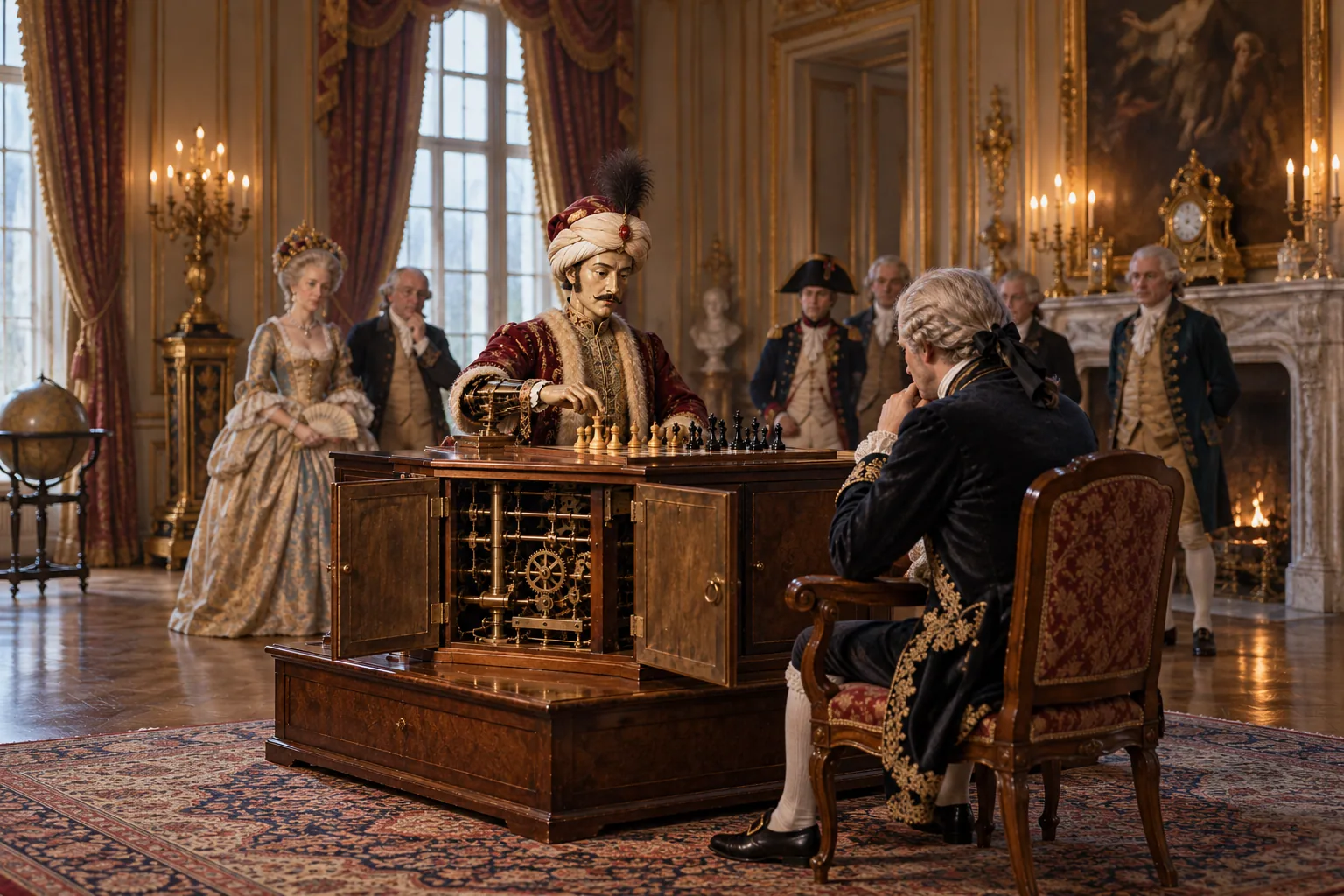
In 1770, Wolfgang von Kempelen presented something extraordinary to the court of Empress Maria Theresa in Vienna.
It was a man sitting at a chessboard.
Or, at least, something that looked like one.
The figure wore robes and a turban and sat behind a large wooden cabinet. Doors in the cabinet could be opened to reveal an impressive collection of gears, wheels and mechanisms. Once the demonstration began, an opponent would sit across from the figure, move a chess piece, and wait.
The mechanical man would respond.
It became known simply as the Turk.
Over the decades that followed, the Turk travelled through Europe and America. It played accomplished chess players. Benjamin Franklin encountered it. Napoleon Bonaparte would eventually sit opposite it. Crowds paid to see it, newspapers discussed it and people tried to determine how it worked.
There was only one problem.
The Turk could not play chess.
A skilled person hidden inside the cabinet could.
A Mechanical Age
It is easy to look back at the Turk from the twenty-first century and wonder how anyone could have believed that a mechanical chess player was possible.
That is probably unfair to the people who saw it.
The eighteenth century was already producing astonishing mechanical devices. Precision clockmaking had demonstrated what collections of tiny gears, springs and wheels could accomplish. Automata could imitate animals, play musical instruments, write and draw.
Jacques de Vaucanson had demonstrated his famous Digesting Duck decades earlier. Pierre Jaquet-Droz and his workshop would produce extraordinary mechanical figures. The boundary of what machinery might eventually accomplish was far from obvious.
A finely made watch could itself be a mechanical marvel.
Then Kempelen placed a mechanical person on the other side of a chessboard.
That mattered.
The Turk wasn't merely a box from which chess pieces mysteriously moved. It had a body. It had an arm. It turned towards the board. It occupied the place where another human player should have been.
The audience wasn't simply watching machinery.
It appeared to be watching a mechanical mind.
Inside the Box
Kempelen's achievement was real, but it wasn't artificial intelligence.
Hidden inside the cabinet was a human operator.
The concealment itself was ingenious. Sections of the cabinet could be opened for inspection while the operator shifted position inside, helping preserve the illusion that spectators were looking through the machinery rather than around a hidden person. Magnetic chess pieces allowed the operator to follow moves on the board, while a pantograph-like control system translated the operator's decisions into movements of the Turk's arm.
The intelligence playing the game therefore belonged to a human being.
But that doesn't make the machine uninteresting.
Quite the opposite.
The Turk was an ingenious combination of engineering, human skill, stagecraft and misdirection.
And there wasn't one mysterious chess player who spent the Turk's entire existence folded inside a cabinet. Different skilled players operated it during its long exhibition career. Its success depended partly upon employing people who were genuinely good at chess.
The machine did something important, though.
It concealed them.
The audience saw the Turk's arm move.
They did not see the mind deciding where it should move.
The Magician's Trick
Calling the Turk simply a fraud misses much of what makes it interesting.
Knowing that a magician has not really made someone disappear doesn't destroy a good illusion. Once the secret is revealed, our fascination simply moves somewhere else.
The question changes.
Before we know the secret, we ask:
How can that possibly happen?
Afterwards, we ask:
How did they make me believe that happened?
The Mechanical Turk deserves the same treatment.
The interesting question is not merely how Kempelen hid a chess player inside a cabinet.
It is how he persuaded an audience to look directly at the intelligence in front of them and place it in the wrong location.
Authority Joins the Performance
As the Turk became famous, another mechanism began working alongside the gears.
Reputation.
Benjamin Franklin, himself fascinated by science and invention as well as a keen chess player, saw the Turk. Later, Napoleon played against it.
These encounters mattered beyond the games themselves.
Imagine hearing about the Turk without ever having seen it.
Empresses and aristocrats had watched it. Scientists and intellectuals had examined it. Famous chess players had faced it. Napoleon himself had sat across the board from it.
Surely, you might think, somebody amongst all those important and intelligent people would have discovered the secret if it were merely a trick.
The Turk's popularity therefore reinforced its credibility.
Every prestigious encounter became part of the next audience's expectations.
Authority had joined the illusion.
Not because those famous spectators necessarily declared that the machine genuinely thought, but because their participation helped make the extraordinary machine seem worthy of serious attention.
The reputation of the Turk began doing some of the work that its gears could not.
The Audience Completes the Trick
Perhaps the cleverest part of the Turk was something Kempelen didn't need to construct at all.
The audience supplied it.
The Turk didn't have to announce:
I understand chess.
It moved a chess piece.
The spectator did the rest.
A mechanical figure sat where a chess player normally sat. It observed a move — or appeared to. It responded appropriately. Sometimes it won.
From observable behaviour, the audience inferred an internal capability.
We have seen something similar before.
Vaucanson's Digesting Duck appeared to eat and digest food. The visible behaviour encouraged spectators to imagine a biological process occurring inside the machine.
With the Turk the inference went further.
The visible behaviour suggested not digestion, but intelligence.
The Duck encouraged people to put a biological process where there wasn't one.
The Turk encouraged people to put intelligence where it wasn't.
The Name Survived
More than two centuries later, the name of Kempelen's machine found an unexpected second life.
Amazon called its crowdsourcing service Mechanical Turk. The idea behind the name was particularly appropriate: tasks that computers struggled to perform could instead be completed by human workers behind a digital interface.
Once again, human intelligence could sit behind a machine and remain largely invisible to the person receiving the result.
There is a remarkable final twist.
Amazon Mechanical Turk is scheduled to close permanently on 30 September 2026.
As this article is being written, the modern service carrying the Turk's name has only days left to run.
The original illusion, however, has not become obsolete.
If anything, our expectations have made it more interesting.
Build the Turk Again
Now imagine that we rebuild the Mechanical Turk today.
We reproduce the cabinet.
We reproduce the gears.
We reproduce the mechanical figure.
We hide an excellent human chess player inside it.
Then we place it in a shopping centre and invite people to play.
The trick could be essentially the same as it was more than two centuries ago.
But the audience would be different.
Very few people would look at the Turk playing excellent chess and conclude that there must be a person folded inside the cabinet.
Ten or fifteen years ago, many might have assumed that a human operator was controlling it remotely.
Before that, perhaps there was a computer concealed somewhere inside.
Today?
Most people would probably shrug.
It's AI.
And that is where the Mechanical Turk becomes interesting all over again.
The machine has not changed.
The trick has not changed.
The hidden chess player has not changed.
The assumption has.
In 1770, the extraordinary possibility was that clockwork might somehow be capable of playing chess.
Today, the ordinary explanation would be that artificial intelligence is doing it.
The magician's trick still works because an illusion does not depend only upon what is hidden.
It also depends upon what the audience expects to find.
Where Was the Intelligence?
So where, exactly, was the intelligence of the Mechanical Turk?
Not in the gears.
Not in the wooden figure.
The immediate chess intelligence belonged to the skilled human operator concealed inside the cabinet.
But Kempelen supplied something different.
He built the mechanism that allowed one kind of intelligence to appear somewhere else.
The operator chose the move.
The mechanism transmitted it.
The mechanical figure performed it.
And the audience decided what it meant.
That makes the Turk more than an amusing historical deception.
It is an early demonstration of how readily we can attribute intelligence to the thing in front of us, while remaining unaware of everything behind it.
More than 250 years later, we are surrounded by machines capable of producing behaviour that would have made the Turk seem almost quaint.
They speak.
They write.
They answer questions.
They create images.
They play games far beyond the level of almost any human being.
The technology is completely different from Kempelen's cabinet, and modern artificial intelligence should not be confused with a hidden human pulling levers.
But the old question survives.
When we observe apparently intelligent behaviour, how much can that behaviour alone tell us about where the intelligence comes from?
The Mechanical Turk did not create artificial intelligence. It displaced real intelligence, hiding its source while leaving its behaviour in plain sight.
In 1770, an audience could look at that behaviour and wonder whether clockwork had learned to think.
Rebuild the same machine today and we would probably reach a different conclusion.
It's AI.
Same machine.
Same hidden intelligence.
Same illusion.
The assumption has changed.