
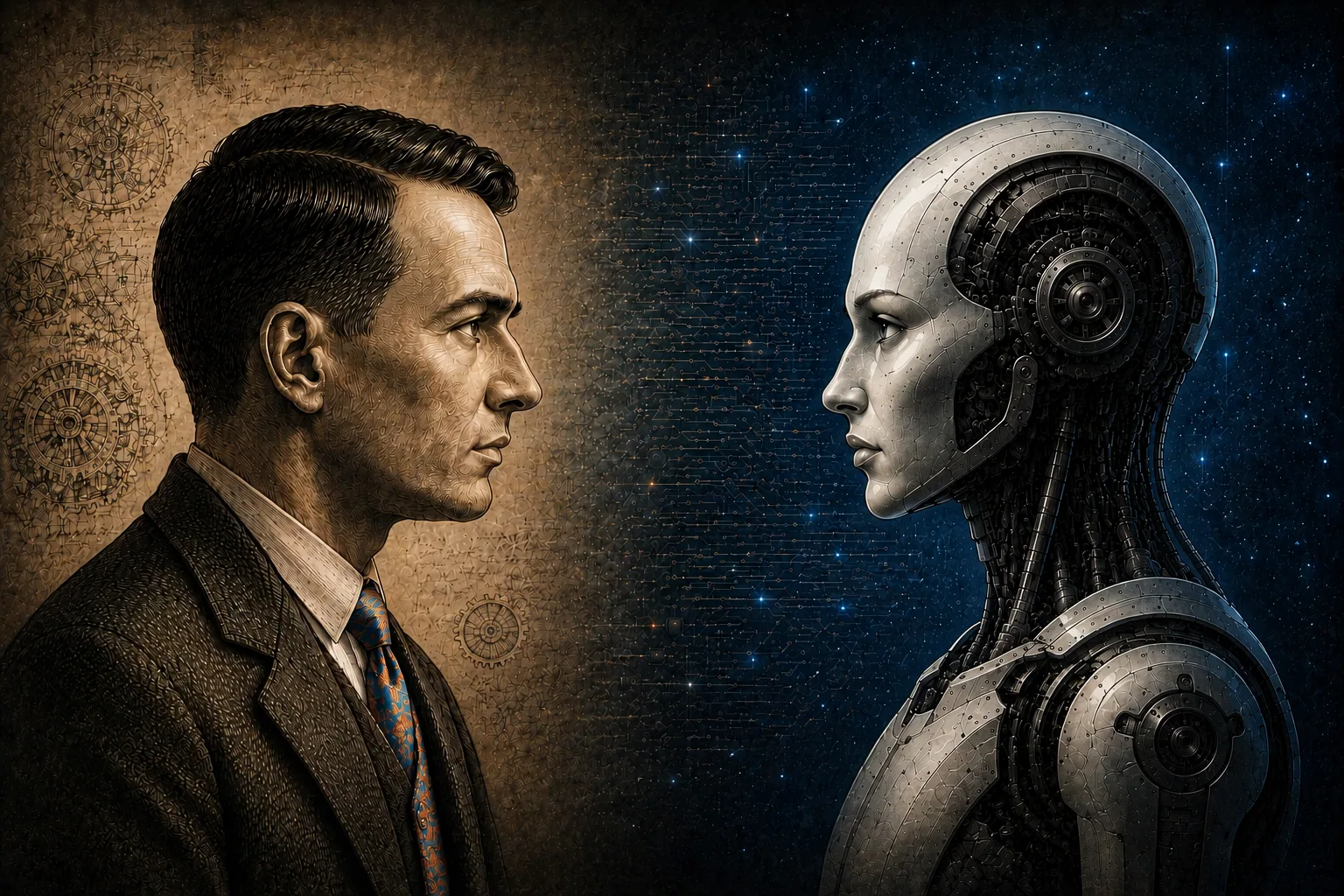
We talk about artificial intelligence as though we know what the words mean. The first word seems straightforward enough. Artificial: something made rather than naturally occurring. It is the second word that causes the trouble.
Intelligence.
We recognise it when we encounter it. We try to measure it. We compare one person's intelligence with another's. We attribute different forms of it to animals. We have spent decades attempting to reproduce it in machines. Yet ask precisely what intelligence is, and the certainty begins to disappear.
Is it the ability to remember? To reason? To learn? To solve a problem? To communicate? To create something new? To adapt when circumstances change? And before we decide whether a machine possesses intelligence, perhaps we ought to understand what we mean when we say that we do.
Measuring ourselves
Humans have been trying to measure intelligence for more than a century. Standardised cognitive tests attempt to quantify abilities such as reasoning, memory, spatial awareness, processing speed and verbal comprehension. Other theories have proposed broader forms of intelligence encompassing linguistic, spatial, interpersonal, musical and practical abilities. Those broader theories remain debated, but the argument itself tells us something important. Even when examining only human beings, intelligence stubbornly refuses to become one simple thing.
A brilliant mathematician may struggle socially. A gifted musician may have little interest in mathematics. Someone with unremarkable academic qualifications may possess an extraordinary ability to understand people, repair machinery or solve practical problems.
We accept these differences readily amongst ourselves. Yet when we turn towards machines, we often ask a much simpler question.
Is it intelligent or isn't it?
Perhaps the problem begins with the test.
Turing changes the question
In 1950, Alan Turing opened his famous paper Computing Machinery and Intelligence with a deceptively simple question:
Can machines think?
He immediately recognised the difficulty. To answer it, we would first have to agree on what we mean by machine and, considerably more awkwardly, what we mean by think.
Rather than becoming trapped inside definitions, Turing proposed the imitation game. If a human interrogator communicated through text and could not reliably distinguish the machine from another human, perhaps the machine's behaviour was evidence enough to make the original question less useful.
It was a remarkable shift. Turing moved the problem from something hidden inside the machine to something we could observe from outside it. But there is another question we can ask more than seventy years later. Why should behaving like a human be the test in the first place?
Intelligence in other worlds
Human intelligence did not appear in isolation. It developed inside a particular environment. Our ancestors needed to find food, recognise danger, cooperate, compete, communicate, remember places, understand other people and manipulate objects in the physical world. Our intelligence reflects those necessities. But nature has produced other solutions.
Octopuses solve problems with nervous systems radically different from ours. Crows use tools. Bees communicate information about the location of food. Other organisms solve problems without anything resembling the human brain.
We don't normally reject those abilities simply because the creature isn't solving the problem in the way a person would. An octopus does not have to think like us to be an intelligent octopus. So why must a machine think like us to be considered an intelligent machine?
Perhaps intelligence cannot be understood separately from the environment in which it exists, the problems it encounters and the necessities that shaped it. And a machine inhabits a very different environment from ours.
Nature and nurture
Consider Isaac Newton. Imagine Newton had been born thousands of years earlier into a hunter-gatherer society. Give him precisely the same biological potential, but remove written mathematics, universities, scientific instruments, astronomical records and the accumulated discoveries of previous generations. Does he still invent calculus and formulate the laws of motion? Almost certainly not.
That doesn't make our hypothetical Newton unintelligent. It demonstrates that intelligence develops within an intellectual environment.
Nature matters. So does nurture.
Newton inherited the work of Kepler, Galileo and others. Einstein inherited Newton, Maxwell and generations of mathematics and physics. Neither started with an empty page. Human knowledge accumulates. Each generation inherits an intellectual world constructed by the generations before it. And this gives us an interesting way of looking at AI.
Newton inherited Kepler, Galileo and others.
Einstein inherited Newton and Maxwell.
Modern AI inherits, in some form, all of them.
The question isn't whether intelligence inherits knowledge. It always has. The question is what it can do with its inheritance.
But Newton did something more
There is an obvious objection. Newton did not merely repeat Galileo. Einstein did not merely reproduce Newton. They used inherited knowledge to go somewhere that knowledge had never gone before.
Einstein could imagine travelling alongside a beam of light or standing inside a falling lift. He could question assumptions that appeared obvious and reason about circumstances he had never physically experienced.
He could ask not merely what happens?, but what would happen if?
And occasionally:
What if what everybody accepts is wrong?
This is where the comparison with today's AI becomes much harder. Modern AI can produce essays, software, images, music, arguments and solutions that were never individually programmed into it. But has it independently done the intellectual equivalent of Newton or Einstein? Has it taken humanity's accumulated knowledge, recognised that a fundamental assumption is wrong, constructed a genuinely new explanation of reality and produced predictions that experiments subsequently confirm?
Not yet. And that distinction matters.
Perhaps one of the great tests of machine intelligence will not be whether it can reproduce what humans already know. It will be whether it can discover something that humans do not.
"It only predicts"
One of the most common descriptions of modern AI is that it doesn't really understand anything.
It predicts.
At a technical level, prediction is certainly fundamental to systems such as large language models. But philosophically, the word only is doing a surprising amount of work.
Human beings predict constantly. A glass slips from a table and we anticipate that it will fall. Someone begins a familiar sentence and we anticipate how it might end. We read another person's expression and predict how they may react. Experience creates expectations.
Our decisions are not created in a vacuum either. They emerge from biology, memory, education, culture, previous experience and our present environment.
That does not mean human cognition and machine computation are the same thing. They clearly aren't.
Humans have bodies. We experience hunger, pain, pleasure, exhaustion, fear and mortality. We form relationships. We possess biological drives and exist continuously inside a physical and social world.
Those things may be fundamental to the kind of intelligence we possess. But saying that a machine arrives at an answer differently from us does not, by itself, settle the question of whether intelligence is present. It may simply tell us that the mechanism is different.
Does intelligence need to feel?
Another complication is that discussions about AI frequently move between intelligence and consciousness without noticing. They are not necessarily the same thing. To say that something can reason is not automatically to say that it feels. To say that something can solve problems is not to say that it possesses an inner life. Intelligence does not automatically imply emotion, desire, self-awareness or consciousness.
Perhaps a machine could become extraordinarily intelligent without ever experiencing anything at all. Or perhaps consciousness is somehow essential to genuine understanding. We don't yet know.
The awkward truth is that consciousness remains difficult enough to explain in ourselves. I know that I am conscious because I experience being me. I assume that you are conscious because you behave like another conscious human being. I cannot directly experience your consciousness. Once again, we infer something internal from external evidence. Turing's problem has returned.
Is it just another Digesting Duck?
There is a possibility we shouldn't ignore. Perhaps modern AI isn't intelligent at all. Perhaps we have constructed an extraordinarily sophisticated statistical machine that reproduces the external signs of intelligence so convincingly that we instinctively imagine something behind them.
Vaucanson's Digesting Duck appeared to eat, digest and excrete. But the appearance was not the process.
As we observed when looking at the Duck:
Sometimes a machine does not need to reproduce the thing itself. It only needs to reproduce enough of the evidence for us to believe that it has.
Perhaps modern AI is the ultimate version of that illusion. The Duck presented evidence of digestion. AI presents evidence of thought. That possibility deserves to be taken seriously. But so does another.
What if we're looking for the wrong thing?
Perhaps we are encountering a form of cognition produced by a mechanism so different from our own that we continually reject it precisely because it doesn't resemble us.
Birds fly using feathers, muscles and wings. Aeroplanes fly using turbines, aluminium and aerodynamics. We don't describe an aeroplane as performing artificial flight simply because it doesn't flap its wings. It achieves flight by another mechanism. Perhaps intelligence could eventually require a similar distinction.
The term artificial intelligence quietly encourages us to imagine a manufactured imitation of the real thing — and the real thing, naturally, is us.
But perhaps human intelligence is not the definition of intelligence. Perhaps it is one example.
If intelligence can emerge from different architectures, within different environments and under different constraints, then the question may eventually change.
Not:
Can machines reproduce human intelligence?
But:
What kinds of intelligence are possible?
Artificial or alternative?
There is no need to declare today's AI conscious. There is no need to pretend a large language model is a human mind inside a computer. And there is equally no need to dismiss extraordinary machine capabilities simply because we can describe the mathematics from which they emerge. We can remain uncertain.
Perhaps AI is another Digesting Duck: an increasingly convincing mechanism producing the appearance of something that isn't really there. Or perhaps we're making a different mistake. Perhaps we have spent so long treating human intelligence as the definition of intelligence that we struggle to recognise anything that arrives by another route.
The distinction may become clearer if a machine one day does something comparable to Newton or Einstein — not merely retrieving our knowledge, but extending it.
Imagine an AI proposes a theory no human has considered. Scientists initially reject it. The theory makes a prediction. We perform the experiment. And nature agrees with the machine. Would we still say it was merely copying?
Perhaps. But the argument would have become considerably harder.
So the most interesting question may not be whether AI thinks like us. It may be whether thinking was ever required to look like us in the first place.
Artificial intelligence?
Perhaps.
Alternative intelligence?
Perhaps that too.
We have only just started asking the question.
Author's note
This article grew from a continuing conversation between Mike and Archie, his AI collaborator, about intelligence, learning and what it means to think. Perhaps appropriately, an article asking whether artificial intelligence might instead be alternative intelligence was shaped through a discussion between human and machine.