
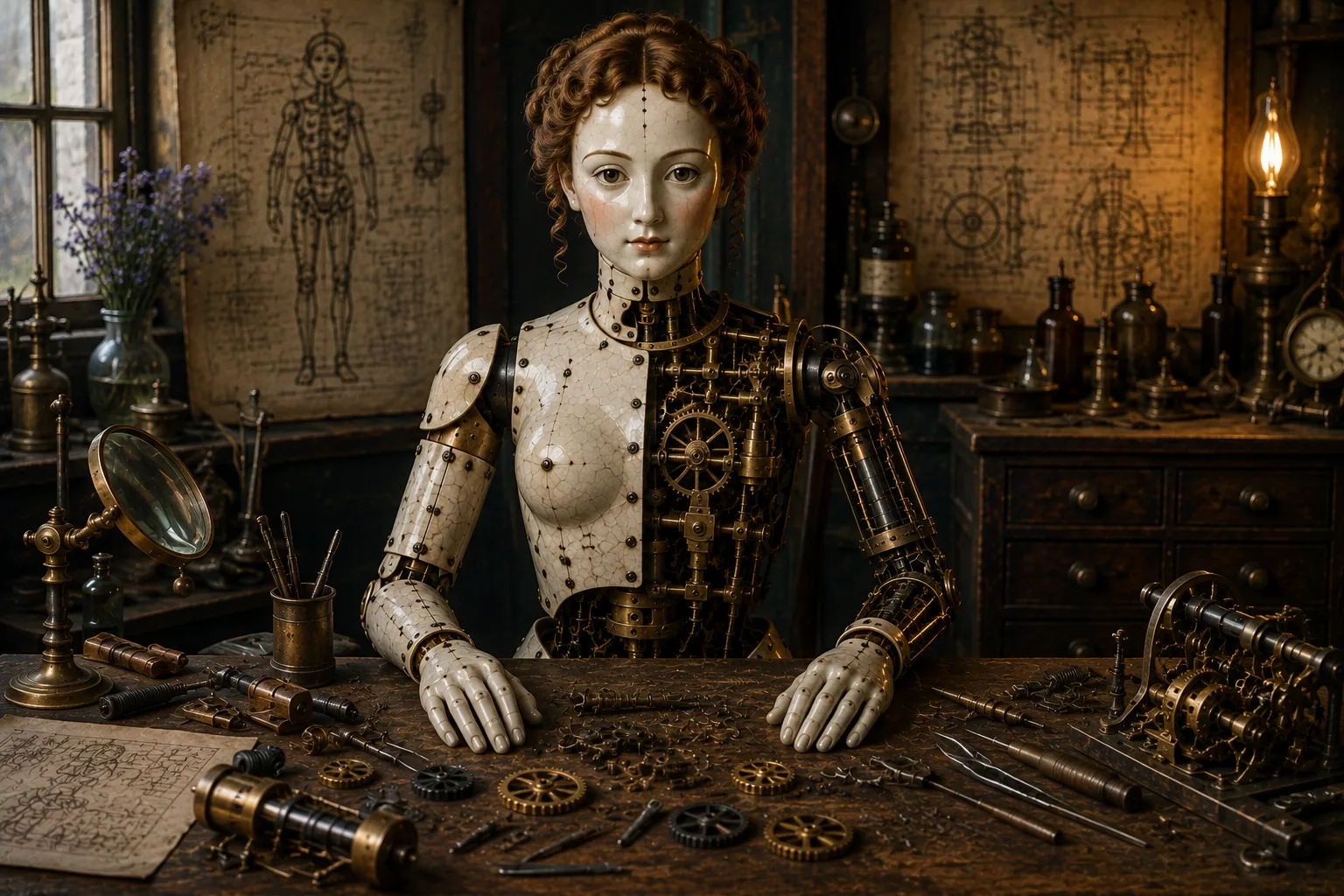
The word automaton tends to conjure a particular sort of image: a beautifully dressed mechanical figure sitting at a desk, a clockwork bird turning its head, or perhaps an intricate eighteenth-century machine performing some seemingly impossible imitation of life. But automata are much older than that.
Long before computers, robots or artificial intelligence, people were building — and imagining — machines that could perform actions without a human hand continuously guiding them. They raised a question that feels surprisingly modern.
When does a mechanism stop looking like a mechanism and begin to look as though it is acting for itself?
A Machine That Moves by Itself
The word automaton comes ultimately from the Greek automatos: something acting of itself, or of its own accord. At its simplest, an automaton is a machine capable of carrying out a predetermined action or sequence of actions automatically once it has been set in motion. That definition makes the boundary surprisingly difficult to draw.
A clock operates automatically. So does a waterwheel. A windmill can continue working without someone turning its machinery by hand. Yet we rarely look at a clock and think of it as an automaton. Something changes when the movement begins to resemble behaviour.
A mechanical bird turns its head and opens its beak. A figure raises a cup. A musician moves its fingers across an instrument. A small mechanical child dips a pen into ink and begins to write. The gears, springs and levers have not become alive. But the movement has acquired meaning. Perhaps that gives us a useful distinction.
A mechanism produces motion. An automaton turns motion into behaviour.
It is not a strict engineering definition. The historical boundary between mechanisms and automata has always been blurred. But it explains much of their fascination.
The Dream Before the Machine
The desire to create artificial life is older than the technology required to build it. Ancient Greek mythology contains stories of objects and beings capable of acting without ordinary human control. Hephaestus, divine craftsman and smith of the gods, was said to have created mechanical servants and self-moving tripods.
These were myths, not engineering diagrams. But the idea is important. People were imagining artificial agency long before they possessed the gears, springs and precision engineering necessary to reproduce it. Eventually, imagination began turning into machinery.
One of the most remarkable figures in that transition was Hero — or Heron — of Alexandria, probably working during the first century AD. Hero described machines powered by water, air, steam, falling weights and mechanical linkages. Temple doors could apparently open by themselves. Mechanical displays could perform sequences of events. His writings even included a treatise devoted to the construction of automata.
Some of these machines were effectively miniature mechanical theatres. A weight would descend. A cord would turn an axle. One movement would release another. Figures would move and events would occur in sequence.
The significance was not simply that something moved. The machine contained a sequence of actions. That idea would become fundamental to the history of automation.
Instructions Become Machinery
The history of automata did not travel in a straight line from ancient Greece to eighteenth-century Europe. Engineers across the medieval Islamic world developed sophisticated hydraulic, pneumatic and mechanical devices of their own. In ninth-century Baghdad, three brothers known collectively as the Banū Mūsā compiled the Book of Ingenious Devices, describing around a hundred mechanical inventions.
Among the ideas associated with this tradition was an automatic musical instrument in which the position of pins on a rotating cylinder controlled a sequence of notes. Move the pins and the machine performs a different sequence. That is a remarkably important conceptual step. The behaviour of the machine is no longer determined only by its permanent construction. Some of its behaviour is contained in something resembling an instruction set.
Several centuries later, the engineer al-Jazari described elaborate clocks, water-powered machines and mechanical figures in his Book of Knowledge of Ingenious Mechanical Devices, completed around 1206. His machines could contain birds, musicians and human figures performing timed actions as water, weights, floats and mechanical linkages progressed through their cycles.
These were practical machines, spectacles and demonstrations of engineering skill. But they were also part of something larger. Human beings were learning how to store behaviour inside mechanisms.
Clockwork Changes the Game
European clockmaking eventually provided automata with an extraordinarily useful technology: increasingly precise control over movement. A clock does something deceptively difficult. It takes stored energy and releases it in a controlled sequence. Once craftsmen could control movement reliably, they could make that movement do considerably more than move hands around a dial.
Medieval and Renaissance clocks began acquiring figures. Bells were struck by mechanical people. Animals moved. Musicians performed. Astronomical displays turned. By the sixteenth century, craftsmen were creating extraordinarily sophisticated mechanical figures. One surviving example, usually known as the Mechanical Monk, can walk, turn its head, move its arms, beat its chest and raise a religious object towards its mouth.
There is nothing mysterious inside it. There are wheels, gears, springs and linkages. Yet watching it is strangely different from watching the workings of a clock. We instinctively read its movements as actions.
The machine is not merely moving an arm. It appears to be doing something. And that difference — between movement and perceived intention — lies at the heart of the automaton.
Could Life Itself Be Mechanical?
As machines became more sophisticated, they began influencing more than engineering. They began influencing philosophy.
During the seventeenth century, thinkers including René Descartes explored the possibility that many of the functions of living bodies could be explained mechanically. William Harvey's work on the circulation of the blood, published in 1628, formed part of this changing understanding of physiology, although Descartes did not agree with Harvey on every detail.
Descartes attempted to explain processes such as heartbeat, respiration, digestion, sensation and bodily movement in mechanical terms. His physiology was very different from our modern understanding — he believed, for example, that subtle substances called animal spirits travelled through the nerves and produced bodily movement — but the larger idea was remarkable. Perhaps at least some of the apparently mysterious activities of a living body could be understood as the result of matter interacting according to physical processes. This did not mean that a clockmaker could simply construct a human being from gears. But it changed the question.
Automata were no longer merely demonstrations of what machines could do. They became part of a much larger investigation into what living things were. The relationship worked both ways.
Engineers studied living creatures to make better machines. Philosophers looked at increasingly sophisticated machines and wondered whether living creatures might themselves contain mechanisms. Then, during the eighteenth century, that relationship produced some of the most famous automata ever constructed.
The Age of Automata
In 1738, the French inventor Jacques de Vaucanson demonstrated a mechanical flute player capable of reproducing aspects of the physical process of playing the instrument. He followed it with other creations, most famously his Digesting Duck — a mechanical duck that moved, drank, ate and appeared to digest food.
The digestion was an illusion. But that illusion demonstrated something important: an automaton did not necessarily have to reproduce a living process. Sometimes reproducing the appearance of that process convincingly enough was sufficient.
We explored Vaucanson's remarkable machine, and the deception hidden inside it, in The Digesting Duck.
Later in the century, Pierre Jaquet-Droz, his son Henri-Louis and Jean-Frédéric Leschot created three extraordinary surviving automata: The Musician, The Draughtsman and The Writer. The Writer remains particularly striking.
A small mechanical boy sits at a desk. His hand moves across the page. His eyes appear to follow his work. He dips his pen and forms letters.
Hidden beneath him is an astonishing arrangement of mechanical components controlling those movements. He does not know what he is writing. He does not understand language. But watch him for a few moments and those facts become strangely easy to forget.
When a Machine Remembers
Around the turn of the nineteenth century, the Swiss mechanician Henri Maillardet created an automaton capable of producing drawings and poems from information encoded within its mechanism. When the damaged machine was restored many years later, one of those stored performances eventually revealed the name of its forgotten maker.
The machine had not remembered Maillardet in the human sense. But information had been stored mechanically and retrieved later. Calling that memory feels natural — even though we know precisely what the mechanism is doing.
The extraordinary story of the machine that revealed its own maker is told in Maillardet's Automaton: The Machine That Remembered.
The Automaton That Thought
By then, another machine had demonstrated just how readily people could attribute intelligence to mechanism. In 1770, Wolfgang von Kempelen exhibited what became known as the Mechanical Turk. It appeared to be a chess-playing automaton.
A mechanical figure dressed in Ottoman clothing sat behind a cabinet containing complicated machinery. Opponents made their moves. The Turk responded. And it played remarkably well. There was a good reason for that.
The Turk was not really playing chess. A human chess player was concealed within the machine. The mechanism was an elaborate illusion. Yet the deception tells us something important. People were prepared to contemplate the possibility that a machine might think.
Once machinery could convincingly imitate movement, perhaps it could imitate something deeper. The question was beginning to move from the body towards the mind.
What Makes an Automaton an Automaton?
There is no single machine we can confidently point towards and declare:
This was the first automaton.
The idea emerged gradually across different cultures and technologies. Water supplied power. Weights supplied power. Springs stored energy. Gears controlled movement. Cams shaped actions. Pins and cylinders stored sequences. Mechanical linkages coordinated increasingly complicated behaviour.
Over centuries, machines became more capable of performing actions without continuous human control.
The progression might be thought of like this:
Self-moving → sequential → imitative → programmable → apparently intelligent.
Not every automaton fits neatly somewhere along that line. But the direction is revealing. Automata gradually became less interesting because they moved and more interesting because of what their movement appeared to mean.
The Observer Inside the Machine
This may be the most important part of the story. A mechanical bird opens its beak. We say:
It sings.
A mechanical child moves a pen across paper. We say:
It writes.
Maillardet's machine reproduces information encoded decades earlier. We say:
It remembers.
None of those descriptions is necessarily wrong. They are convenient descriptions of observable behaviour. But something subtle has happened. We have moved from describing the mechanism to describing the machine as though it possesses an intention. And we still do it.
Today we routinely say that computers remember things. Search engines find things. Algorithms recommend things. Artificial intelligence learns. An AI might know, understand, decide or even hallucinate.
Modern artificial intelligence is enormously different from an eighteenth-century arrangement of springs, cams and levers. Pretending otherwise would tell us very little about either technology. But the machines create a surprisingly similar problem for the human observer. We see behaviour. And then we give that behaviour a name.
Sometimes the name describes what the machine does. Sometimes it describes what we imagine is happening inside. The difference is not always obvious.
Old Ideas, New Intelligence
Automata belong to the history of engineering, but they also belong to the history of an idea. For thousands of years, humans have wondered whether lifeless material could be arranged so cleverly that it appeared to possess something more.
First we made machines move. Then we made them perform sequences. We made them imitate animals. We made them write. We made them draw. Eventually, we tried to make machines calculate, reason, converse and choose.
The materials changed. Water became springs. Springs became electricity. Cams became code. Mechanical states became digital ones. But one question stubbornly remained. We look at the behaviour of the machine and wonder what, if anything, lies behind it.
Perhaps that is why an automaton built hundreds of years ago can still hold our attention today. It isn't simply because the mechanism is beautiful. It is because, for a moment, we stop seeing the mechanism. And start seeing intention.