
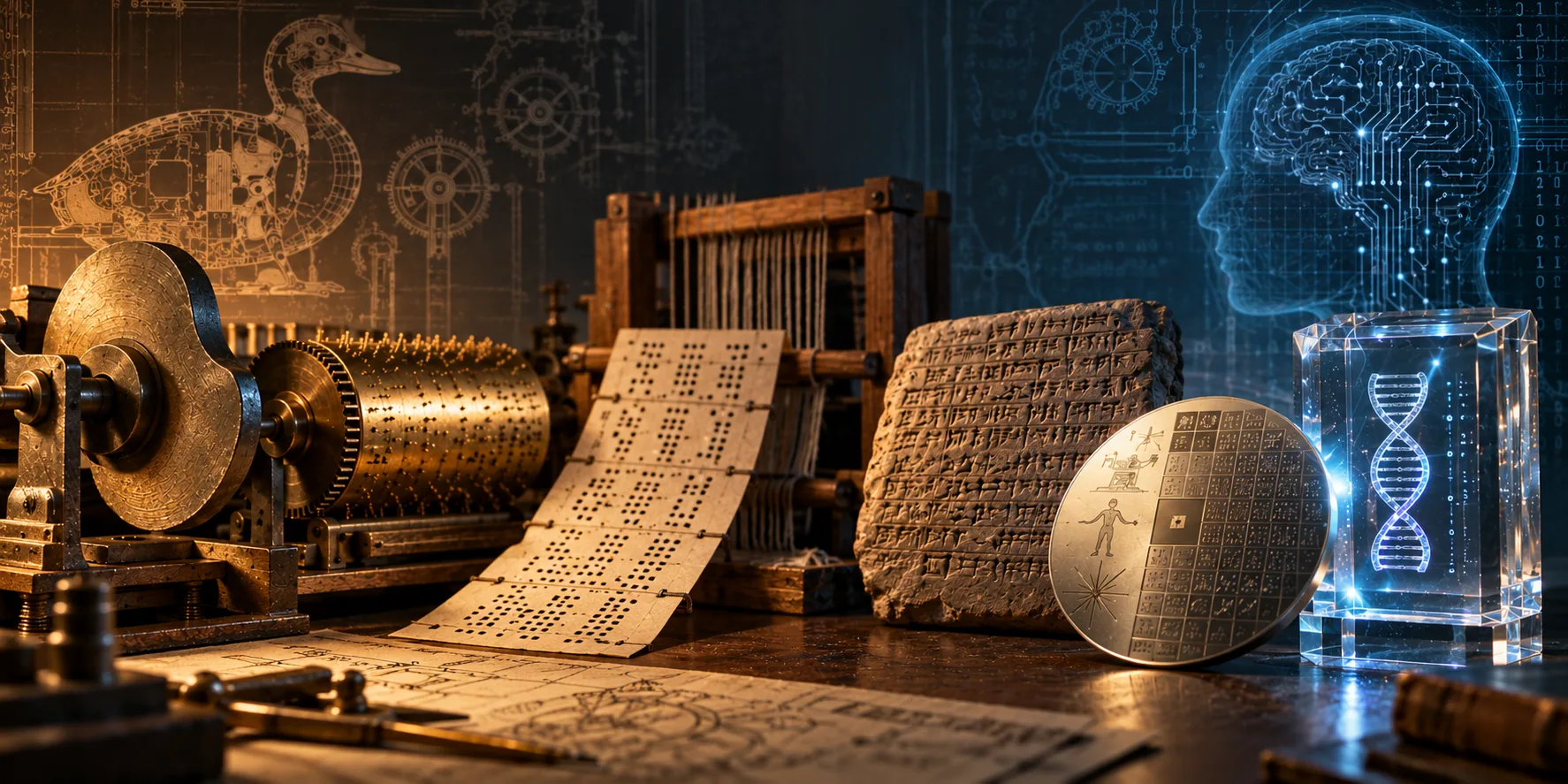
Long before computers stored data, machines were already preserving information.
We tend to think we know what memory is.
For us, memory is personal. A face. A place. A conversation. Something that happened yesterday, or something from childhood that returns unexpectedly decades later.
For a computer, the word seems to mean something entirely different: bits, storage, electronic states and data waiting to be retrieved.
But we already use memory in ways that have little to do with conscious recollection.
We talk about muscle memory when a pianist's fingers seem to remember a sequence of movements. Biology preserves genetic information in DNA, copying instructions from one generation to another. Materials can be engineered to return to a remembered shape. Computers store information electronically. Experimental crystal memories can preserve digital information as microscopic changes inside glass.
These things are profoundly different.
Yet they share something.
Information from an earlier moment has been preserved in a form that can affect something later.
Perhaps that gives us a useful definition.
Memory is information from the past, preserved in a form that can influence the future.
If we accept that, machines may have learned to remember much earlier than we usually imagine.
A Shape That Remembers
Open an eighteenth-century automaton and among its gears, springs, levers and shafts you may find something deceptively simple.
A cam.
A cam is an irregularly shaped mechanical component. As it rotates, a follower moves across its surface. Changes in the cam's profile are translated into movement elsewhere in the mechanism.
At first glance it is simply another mechanical part.
But look at it differently.
Someone determined the shape of that cam before the machine began to move. Its rises and falls determine what the mechanism will do later. One part might lift an arm. Another might lower it. Several cams working together can coordinate movements into an elaborate sequence.
The movement has been decided in advance and preserved physically.
The shape contains information.
So does the cam have memory?
If memory requires consciousness, obviously not.
But that definition would also make much of what we routinely call computer memory rather difficult to explain. A memory chip doesn't remember its contents consciously either.
If memory instead means preserving information so that it can influence future behaviour, the distinction becomes much less comfortable.
The cam remembers.
Not as we do.
Mechanically.
Music Stored in Metal
This isn't merely a modern metaphor imposed on an old machine.
Long before electronic recording, automatic musical instruments were physically storing music.
A surviving musical clock from around 1625 in the Metropolitan Museum of Art contains a sixteen-note pipe organ and sixteen-string spinet. Its three airs are stored on its original pinned cylinder. As the cylinder rotates, its arrangement of pins causes the mechanism to reproduce music encoded into it centuries ago.
The cylinder does not understand the music.
It cannot enjoy it. It cannot decide that it prefers another tune. It cannot improvise.
But information has been preserved in its physical structure and, when read by the mechanism, that information becomes behaviour.
Something from the past has been made available to the future.
That sounds remarkably like memory.
But there is a limitation.
The memory is part of the mechanism.
What happens when it can be removed?
When Memory Left the Machine
The answer leads towards weaving.
In the early eighteenth century, inventors began experimenting with perforated paper and punched cards to control textile machinery. Basile Bouchon used perforated paper in 1725. Jean-Baptiste Falcon developed the idea using connected punched cards a few years later.
Jacques de Vaucanson later worked on an automated loom controlled by a perforated cylinder.
We have met Vaucanson before on Cog & Code through his extraordinary Digesting Duck. His attempts to reproduce living behaviour mechanically are part of the history of automata. His work on weaving leads us towards another history: machines whose behaviour could be controlled by stored information.
Then came Joseph Marie Jacquard.
By the beginning of the nineteenth century, the Jacquard system used chains of punched cards to control which warp threads were raised as weaving progressed, allowing complex patterns to be reproduced automatically.
Something important had happened.
With a cam or pinned cylinder, information is closely bound to the mechanism.
With a punched card, information can exist separately from it.
Remove the card.
Insert another.
The mechanism remains substantially the same, but its behaviour changes according to the information it has been given.
Memory has become portable.
The machine can remain the same while the instructions change.
And perhaps something else has happened too.
Memory is beginning to separate from the machine that reads it.
A Hole or No Hole
A punched card is almost absurdly simple.
At a particular position there is a hole.
Or there isn't.
Yet combinations of those physical differences can preserve information.
The idea should feel strangely familiar.
Modern computers represent information using discrete states that we conventionally describe as ones and zeroes.
A Jacquard loom was not a computer. But at each relevant position its card presented the mechanism with one of two physical conditions: a hole, or no hole.
The comparison does not make the loom a digital computer.
It reveals something more fundamental.
Information can be represented through distinguishable physical states, stored outside the mechanism, transported and later interpreted by a machine.
And unlike the information hidden inside many modern storage devices, the card exposes its information-bearing structure.
You may not know what its holes mean.
But you can see that a pattern exists.
Once information can exist independently of the mechanism acting upon it, an important boundary has been crossed.
The machine is no longer defined entirely by what its mechanism was built to do.
Increasingly, what it does can depend upon the information it receives.
That road eventually leads towards Charles Babbage and his Analytical Engine, whose design would use punched cards to control operations.
But that is another story.
For now, it is enough to notice what has changed.
We are no longer merely building behaviour into machines.
We are giving machines something they can read.
An Ancient Idea
Thousands of years before the floppy disk, hard drive or cloud, humans had already discovered an exceptionally effective way of sending information into the future.
They carved it into something that would survive them.
Stone.
Clay.
Metal.
The principle was wonderfully simple.
Make information part of the physical object.
An inscription does not need electricity. It doesn't require an operating system. There is no manufacturer who must continue supporting it.
If the object survives, the information-bearing marks can survive with it.
More importantly, those marks announce their presence.
A future observer may not understand the language carved into a stone tablet, but they can see that the marks are deliberate.
They know they have found information.
Understanding it is the next problem.
An Ancient Idea, Made Microscopic
The Long Now Foundation's Rosetta Project was created partly in response to a distinctly modern problem: digital obsolescence.
Our ability to store information has become extraordinary, but retrieving it often requires the technological world surrounding that information to survive as well.
Magnetic tape gave way to floppy disks, hard disks, optical discs, flash drives and cloud storage. Each brought enormous advantages, but also new dependencies: drives, interfaces, controllers, filesystems, formats, software and services.
The Rosetta Disk takes a strikingly different approach.
More than 13,000 pages documenting over 1,500 human languages are reproduced as microscopic images in nickel.
They are not conventional digital files waiting for compatible software to decode them.
They are pages.
Very, very small pages.
With sufficient optical magnification, they can be seen.
A future civilisation would not need to recreate our computers, operating systems or file formats to reach the representation stored on the disk.
It would need to discover that the surface should be magnified.
Once it did, it would encounter pages, lines and writing.
Understanding the languages might remain an enormous challenge. But reaching the representation itself would not depend upon reconstructing the technological system that created it.
The idea is ancient.
The execution is thoroughly modern.
The Rosetta Disk uses sophisticated manufacturing to return to one of our oldest solutions to remembering.
If you want information to survive, put it into something that will — and give the future a chance of recognising what you have left behind.
Memory in Crystal
Modern research offers another approach.
Researchers at the University of Southampton have developed what is commonly called 5D optical memory.
Using ultrafast lasers, microscopic structures can be written inside fused silica. Information is encoded through properties of those structures, creating extremely dense digital storage with remarkable resistance to heat and environmental degradation.
In 2024, researchers used the technology to store the full human genome.
Think about that journey.
DNA stores biological information.
We read that information.
We translate it into digital data.
A laser then encodes that data as microscopic physical structures inside crystal.
Biological information becomes digital information and then becomes physical structure again.
But the crystal presents a different problem from the Rosetta Disk.
The crystal may survive.
The data may survive.
Yet a distant future reader still has to discover how that data is encoded and construct a means of recovering it.
The Southampton researchers recognised this problem.
The genome crystal includes a visual key on its surface, inspired in part by the plaques sent aboard the Pioneer spacecraft. The clues are intended to indicate what the object contains and provide information that could help an intelligent finder understand how to approach it.
That detail matters.
The researchers were not merely trying to preserve the data.
They were trying to preserve a route back to it.
Preserving memory and preserving access to memory are not the same thing.
The Reader Matters
Every memory has a relationship with a reader.
A cam requires a follower.
A pinned cylinder requires its musical mechanism.
A punched card requires a mechanism to turn its holes into action, although its pattern remains directly visible.
DNA requires biological machinery capable of interpreting its sequence — a reader that evolved alongside the information system itself.
Digital storage requires hardware and software.
A Rosetta Disk requires magnification, after which its pages become visually accessible.
A 5D crystal requires specialised technology and knowledge of its encoding, which is why leaving clues for a future reader becomes important.
So long-term memory presents three separate problems.
Will the information survive?
Will somebody recognise that information is present?
Will they be able to work out how to read it?
Solving one does not necessarily solve the others.
A Message to the Future
Imagine encoding a modern computer file as binary and engraving those bits into a durable metal plate.
The pattern might survive for thousands of years.
A future civilisation could recognise its regularity. It might discover that there are two states. It might even conclude that the information is binary.
Then comes the harder question.
What does it mean?
A sequence might represent a number, a letter, a pixel, compressed data or part of a program.
Now compare that with a page physically reproduced on metal.
Its future reader may not understand the language either.
But the structure provides clues.
There are lines. Repeated symbols. Spaces. Pages that can be compared with other pages.
One method can preserve information much more densely.
The other exposes more of the route towards understanding it.
The best memory is therefore not necessarily the one that survives longest.
It is the one the future can recognise as memory and learn how to read.
The Strange Fragility of Modern Memory
None of this makes physical or mechanical memory superior to electronic memory.
Modern digital storage gives us extraordinary capacity, speed, accuracy, searchability and near-perfect copying.
But it also exists inside a technological ecosystem.
Imagine an archaeological excavation thousands of years from now.
Two objects are discovered.
One is a flash drive.
The other is a stainless-steel plate containing a deliberate pattern of holes.
The flash drive might contain millions of books.
The metal plate might contain only a tiny amount of information.
But the plate immediately reveals its pattern.
The flash drive requires its finder to discover how to communicate with it before they can even ask what it remembers.
Sometimes the primitive memory has one extraordinary advantage.
You can see it.
The Medium Is Not the Memory
A cam preserves information in its shape.
A pinned cylinder preserves music in the position of its pins.
A punched card preserves information through holes.
DNA preserves biological information in molecular sequences.
A Rosetta Disk preserves microscopic page images in nickel.
A 5D crystal preserves digital information through microscopic structures in glass.
Electronic memory preserves information through electrical, magnetic or other physical states.
The materials could hardly be more different.
Wood.
Brass.
Paper.
Metal.
Molecules.
Glass.
Silicon.
Yet the underlying idea keeps returning.
Preserve a difference.
Preserve a pattern.
Allow that pattern to affect something later.
And that brings us to artificial intelligence.
When an AI Remembers
Today we casually ask whether an AI remembers us.
The phrase feels natural.
Yet an AI does not remember in the way a human being does.
Depending upon the system, information affecting a later answer might come from the immediate conversation, stored records, retrieved documents, external databases or other computational state.
Nevertheless, if something from an earlier interaction is preserved and subsequently influences what the system does, we readily describe the result as memory.
So why should information preserved electronically qualify as memory while information preserved geometrically does not?
Why is a value retained by a computer memory, while the shape retained by a cam is merely mechanism?
By the definition we began with, both can be memory.
What changes is what can be done with it.
The cam's memory is essentially fixed. It repeatedly expresses information embodied in its shape.
The punched card separates information from the machine, allowing one stored pattern to be exchanged for another.
Later computer memory becomes rapidly writable and retrievable.
And modern AI systems can encounter stored information alongside new information — retrieving something from before and interpreting it within the context of what is happening now.
That is a significant change.
The cam repeats what its shape remembers.
An AI can encounter what has been remembered in the context of something new.
Its response can therefore depend not simply upon what information has survived, but upon which information is retrieved, what surrounds it and how those pieces are interpreted together.
The sophistication is enormously different.
The underlying principle remains surprisingly familiar.
Something from before influences what happens next.
When Did Machines Learn to Remember?
Perhaps they never suddenly did.
Perhaps there was no moment when a machine crossed some invisible boundary and acquired something called memory.
Instead, humans gradually discovered more sophisticated ways of preserving information and constructing systems capable of reading it.
A groove.
A shape.
A pin.
A hole.
A molecule.
A magnetic state.
An electrical charge.
A microscopic structure in glass.
Different materials.
Different centuries.
Different readers.
The same old problem.
How do we make something that exists now available to something that comes later?
And the further into the future we want that memory to travel, the more important another question becomes.
Will the future know how to listen?
Perhaps memory was never something that belonged exclusively to brains, computers or machines.
Perhaps it is something more fundamental.
A pattern preserved.
A difference maintained.
Information carried from one moment into another.
And perhaps computers did not teach machines how to remember.
Perhaps they simply taught us to recognise how long they had been doing it.
The past does not need to remain alive.
It needs to survive.
And it needs a future that can still read it.